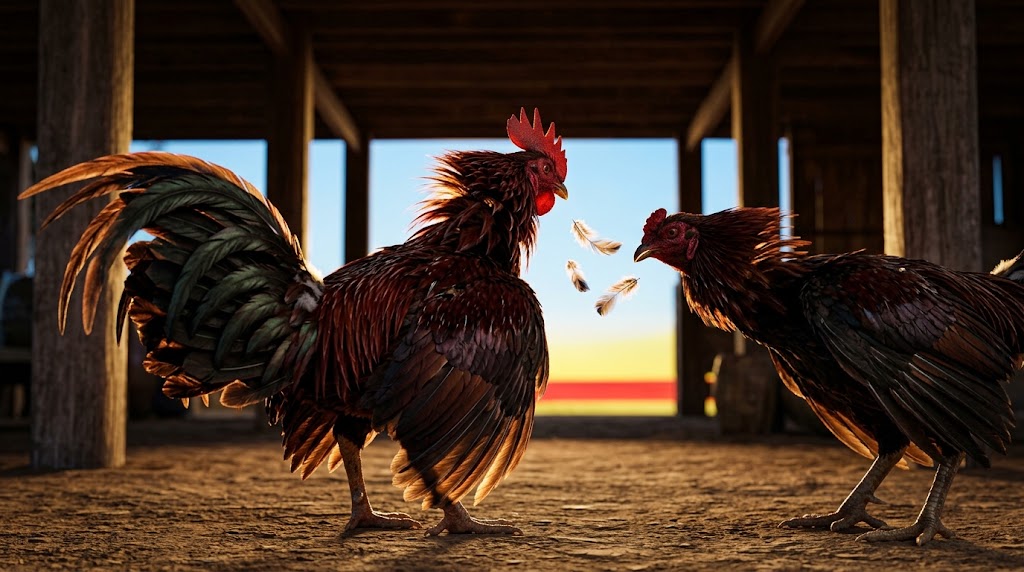
Gamefowl: Meaning, Breeds, Bloodlines and What Genetics Reveals
Gamefowl is a broad term used for domestic chickens from breeds, strains, or breeding lines historically shaped by selective breeding for particular physical and behavioral traits. It is not one single genetically uniform breed. Modern genomic studies show both shared selection-related signals and substantial population diversity among sampled gamecocks.
The clearest way to understand gamefowl is to separate several concepts that are often mixed together: breed, strain, line, bloodline, genetic population, selective breeding, and husbandry. These concepts overlap, but they are not interchangeable.
Key Takeaways
- Gamefowl is not one genetically uniform chicken breed.
- Genomic evidence shows both shared selection-related signals and substantial diversity among sampled gamecock populations.
- A 2024 study found a strong selection signal around ISPD.
- A 2025 whole-genome study reported geographic population structure, multiple-origin patterns, candidate selection signals, and introgression in sampled gamecock populations.
- Breed, strain, line, bloodline, and genetic population should not be treated as interchangeable terms.
- Findings from sampled populations should not automatically be generalized to every gamefowl population worldwide.
What Is Gamefowl?
The simplest gamefowl meaning is a broad category of domestic chickens associated with breeds or breeding lines historically selected for distinctive physical and behavioral traits.
Gamefowl belong to the domestic chicken, Gallus gallus domesticus. Genetic research supports treating the term as broader than a single formal breed because geographically diverse gamecocks do not form one completely homogeneous genetic group.
A 2024 study in G3: Genes, Genomes, Genetics found that geographically diverse gamecocks shared some genetic similarities while still showing substantial diversity among populations.
Evidence verdict: Current genomic evidence supports treating gamefowl as a genetically diverse category rather than a single uniform breed.
Gamefowl vs Gamecock: What’s the Difference?
The cited genomic studies use the term gamecock for the fighting-chicken populations included in their analyses. In this guide, gamefowl is used as the broader category encompassing related breeds, strains, lines, and populations.
Research on sampled gamecocks can therefore inform discussion of gamefowl when each conclusion remains within the scope of the birds and populations actually studied. Findings from those populations should not automatically be generalized to every population described as gamefowl.
For related terminology concerning venues rather than chicken genetics, see Cockfighting Arena. This related resource is separate from the scientific sources used to support genetic claims.
Breed, Strain, Line, Bloodline and Population Are Not the Same
FAO animal-genetic-resource frameworks distinguish among breeds and several types of structured or managed populations, including strains and lines. These categories may reflect differences in breeding history, characteristics, management, or population structure.
| Term | Meaning in This Guide | What It Describes | What It Does Not Prove |
|---|---|---|---|
| Breed | A recognized livestock population distinguished by identifiable characteristics, geography, cultural identity, breeding history, or a combination of these factors. | A broad population identity. | That every member is genetically identical. |
| Strain | A more specific population maintained within or alongside a broader breed. | A narrower breeding group or within-breed type. | That it is automatically a separate formal breed. |
| Line | A population maintained through a particular breeding or selection history. | A focused breeding lineage or program. | That it represents every member of the wider breed. |
| Bloodline | In this guide, bloodline refers to a breeder term commonly used for descent or pedigree within a breeding population. Its use is less standardized in formal animal-genetics frameworks. | Breeding descent or family ancestry. | That it is a formally standardized scientific population category. |
| Genetic population | A group described through genetic relationships, differentiation, ancestry, or gene flow. | Population-genetic structure. | That the genetic group must correspond exactly to a traditional breed name. |
Evidence verdict: Traditional breeding labels and genetic population structure can overlap, but they are not automatically equivalent.
Examples of Gamefowl Breeds and Populations
Recognized chicken breeds with documented game-fowl histories illustrate why gamefowl should not be treated as a single breed.
- Aseel: A distinct heritage chicken breed with a long history in South Asia. Breed record.
- Shamo: A Japanese breed with ancestry historically linked to South Asian game chickens. Breed record.
These breed names represent different histories and should not be treated as interchangeable labels for one genetically identical population.
For additional external browsing, เว็บตรง ปลอดภัย is provided separately from the scientific and institutional evidence used in this guide.
What Did the 2024 Genomic Study Find?
The 2024 G3 study directly compared geographically diverse gamecocks with nongame chickens.
- 44 geographically diverse gamecocks were newly sequenced.
- 62 nongame chickens representing multiple breeds were newly sequenced.
- Previously published genomes were added to create a combined dataset of 307 chickens.
- The sampled gamecocks did not form one homogeneous genetic group.
- An intronic variant at the ISPD locus occurred at approximately 89.5% frequency in sampled gamecocks compared with approximately 3.7% in sampled nongame chickens.
- The ISPD region produced the strongest selection signal reported in the study.
These figures and selection results are reported by Bendesky and colleagues in the 2024 study. Bendesky et al., 2024.
These frequencies apply to the study dataset and should not be presented as universal values for every gamefowl population.
The researchers interpreted the shared genetic similarities among sampled gamecocks as being consistent with a common origin followed by local diversification or mixing with nongame chickens.
Evidence verdict: The study supports both genetic diversity among sampled gamecocks and shared selection-related features, but it does not establish genetic uniformity across all gamefowl populations.
What Did the 2025 Whole-Genome Study Find?
A 2025 study in the Journal of Animal Science and Biotechnology analyzed whole-genome data from 231 chickens. The dataset included gamecocks, Chinese indigenous chickens, commercial chickens, and wild junglefowl.
Thirteen HN gamecocks were newly sequenced at an average depth of approximately 11.10×, while 218 additional genomes came from public datasets.
The population analyses reported clear geographic structure and supported multiple-origin patterns among the sampled gamecock populations.
The researchers used three complementary selection-detection approaches: FST, π-ratio, and XP-EHH. Fifteen shared candidate genes were identified across the three approaches. Xu et al., 2025.
Highlighted candidates included ETV1, DGKB, AGMO, MEOX2, ISPD, and PLCB4.
The paper discusses these candidates in relation to biological functions involving neurodevelopment, skeletal or muscle development, body size, metabolism, and sensorimotor processes.
These are candidate genes and selection signals reported in the studied populations. They should not be described as genes that directly or independently cause a fighting phenotype or determine complex behavior.
Evidence verdict: The 2025 study supports complex geographic population structure, multiple ancestry patterns, and candidate selection signals among the sampled populations.
Do Genetic Studies Agree on the Origin of Gamefowl?
What the 2024 Study Found
The 2024 study found that geographically diverse gamecocks differed genetically while still sharing similarities that distinguished them from nongame chickens. The authors interpreted those similarities as consistent with a common origin followed by later diversification or mixing.
What the 2025 Study Found
The 2025 study examined a broader population framework that included gamecocks, Chinese indigenous chickens, commercial chickens, and wild junglefowl. Its analyses supported multiple-origin patterns and identified evidence of genetic introgression.
Why the Findings Are Not Necessarily Contradictory
The studies used different datasets, comparison populations, analytical methods, and research questions.
The 2024 work emphasized shared genetic differentiation between gamecocks and nongame chickens. The 2025 work examined geographic structure, ancestry, selective sweeps, and introgression across a broader population framework.
A population can share selection-related genetic features while still containing multiple ancestral components, regional divergence, and later gene flow. Shared selection signals do not imply identical ancestry.
What Can Safely Be Concluded?
Taken together, the evidence supports substantial genetic diversity among studied gamecock populations. Some selection-related features are shared across sampled groups, while ancestry and population structure remain regionally complex.
What Cannot Yet Be Concluded?
The evidence does not justify claiming that every gamefowl population has one identical origin, one universal bloodline, or a fixed genetic profile that determines all physical or behavioral traits.
Genetic Evidence Matrix
| Study | Sample / Population | Method | Main Finding | Limitation | Source |
|---|---|---|---|---|---|
| G3 (2024) | 44 newly sequenced gamecocks + 62 nongame chickens; 307 chickens after published genomes were added | Comparative genomic and population-genetic analysis | Sampled gamecocks were genetically diverse but shared distinguishing genetic features; an ISPD variant occurred at about 89.5% in sampled gamecocks vs 3.7% in sampled nongame chickens. | The dataset does not represent every gamefowl population worldwide. | Bendesky et al., 2024 |
| JASB (2025) | 231 chickens: 13 newly sequenced HN gamecocks plus 218 genomes from public datasets | Population structure, FST, π-ratio, XP-EHH, and introgression analyses | Reported geographic structure, multiple-origin patterns, candidate selection genes, and introgression in sampled gamecock populations. | Selection signals and introgression do not by themselves establish causal effects on phenotype or behavior. | Xu et al., 2025 |
What Is Introgression in Gamefowl Genetics?
Introgression is the movement of genetic material from one population into another through interbreeding, followed by persistence of that material across later generations.
The 2025 study reported introgression involving wild junglefowl and specific sampled gamecock populations. A region around MYBPHL was consistent with introgression from Gallus sonneratii into Euramerican gamecocks, while a region around CPZ was consistent with introgression from Gallus gallus gallus into multiple sampled gamecock populations.
The researchers assessed these regions using several forms of genomic evidence, including population-genetic comparisons, phylogenetic relationships, sequence-divergence patterns, and mutation analysis.
The evidence supports historical gene flow. It does not prove that MYBPHL, CPZ, or another introgressed region directly causes a particular appearance, behavior, or performance trait.
Evidence verdict: Introgression is supported in specific sampled populations and genomic regions, but its exact phenotypic consequences remain unresolved.
Characteristics: Phenotype Is Not the Same as Genetic Cause
Descriptions of gamefowl often refer to body structure, muscular development, posture, activity, or behavioral differences. These observations should be separated from genomic evidence.
Observed phenotype is a visible or measurable characteristic in a bird or population.
Genomic association means a genetic region statistically tracks with a population or trait pattern. Association alone does not establish direct causation.
Candidate gene means a gene or genomic region has been highlighted for further investigation because of evidence such as a selection signal. It is not proof that the gene independently determines a complex physical or behavioral characteristic.
Phenotype should also be interpreted in the context of environmental and husbandry factors. FAO poultry-management guidance emphasizes factors including physical environment, nutrition, exposure to disease-causing organisms, stress, and behavioral and social conditions. FAO poultry management and housing guidance.
What Does Gamefowl Raising Involve?
Gamefowl raising begins with general poultry husbandry fundamentals rather than with a particular bloodline label.
FAO poultry-management guidance emphasizes a suitable physical environment, adequate food and water, reduced exposure to disease-causing organisms, and conditions that address physiological, behavioral, and social needs.
These fundamentals apply regardless of breed or lineage. Detailed feeding programs, breeding plans, disease treatment, and age-specific management require more specialized husbandry or veterinary guidance.
What Current Genetic Research Cannot Tell Us
- A result from sampled gamecocks cannot automatically be generalized to every gamefowl population worldwide.
- A selection signal does not prove that one gene independently causes a complex physical or behavioral trait.
- Introgression demonstrates historical gene flow but does not establish the functional effect of every introgressed region.
- A traditional breed or bloodline name does not guarantee genetic uniformity.
- Genomic similarity does not mean two populations have identical histories.
- Different studies can produce different interpretations because they use different samples, comparison groups, methods, and research questions.
Evidence verdict: Current genomic research can identify population structure, selection signals, ancestry patterns, and introgression, but it cannot reduce all gamefowl diversity to one universal genetic explanation.
Another external resource, เว็บพันธมิตร, is provided separately and is not used as evidence for scientific claims.
How This Guide Uses Evidence
Genetic claims rely primarily on peer-reviewed genomic research. Terminology and population classification use FAO animal-genetic-resource frameworks. Breed examples use recognized breed records, while husbandry claims rely on agricultural or veterinary guidance.
Population-specific findings remain within the scope of the populations actually studied. Genetic association, candidate-gene evidence, and introgression are not converted into claims of direct biological causation without supporting functional evidence.
Summary
Gamefowl is best understood as a broad category containing multiple breeds, strains, lines, bloodlines, and genetic populations rather than one genetically uniform breed.
The available genomic evidence shows two patterns at the same time: some sampled gamecock populations share strong selection-related genetic signals, while population structure and ancestry remain diverse and regionally complex.
The 2024 and 2025 studies are therefore not automatically contradictory. Shared selection-related features can coexist with multiple ancestral components, geographic divergence, and later gene flow.
The evidence does not support a universal bloodline, a single genetic profile, or the idea that candidate genes alone determine complex traits.
FAQ
What is gamefowl?
Gamefowl is a broad term for domestic chickens from breeds, strains, or breeding lines historically shaped by selective breeding for particular physical and behavioral traits. It does not describe one genetically uniform breed.
What is the difference between gamefowl and gamecock?
The cited genomic studies use gamecock for the fighting-chicken populations included in their analyses. In this guide, gamefowl is used as the broader category encompassing related breeds, strains, lines, and populations.
Is gamefowl a specific breed?
No. Animal-genetic frameworks distinguish among breeds, strains, lines, and populations, while genomic research shows substantial diversity among sampled gamecock populations.
Are all gamefowl genetically the same?
No. Genomic studies have found substantial diversity and geographic population structure among sampled gamecocks. Shared selection signals can exist alongside different ancestry and population histories.
What did the ISPD study find?
In the 2024 study dataset, an intronic ISPD variant occurred at approximately 89.5% frequency in sampled gamecocks compared with approximately 3.7% in sampled nongame chickens. These values describe the study dataset and should not be treated as universal frequencies for every gamefowl population. Bendesky et al., 2024.
What is introgression in gamefowl?
Introgression is the movement of genetic material from one population into another through interbreeding and inheritance across later generations. The 2025 study found evidence of introgression from wild junglefowl into specific sampled gamecock populations. This demonstrates historical gene flow, not proven causation of a particular phenotype.
Do the 2024 and 2025 genetic studies contradict each other?
Not necessarily. The 2024 study emphasized shared genetic similarities, while the 2025 study examined broader population structure and introgression. Different datasets and analytical approaches can reveal different layers of the same complex population history.
What is the difference between a breed and a bloodline?
A breed is a broader recognized animal population. In this guide, bloodline refers to a breeder term used for descent or pedigree within a breeding population. Its use is less standardized in formal animal-genetics frameworks.
References
Bendesky, A., Brew, J., Francis, K. X., et al. The main genetic locus associated with the evolution of gamecocks is centered on ISPD. G3: Genes, Genomes, Genetics, 2024.
Xu, N., Zhang, L., Chen, F., et al. Population structure, selection signal and introgression of gamecocks revealed by whole genome sequencing. Journal of Animal Science and Biotechnology, 2025.
Food and Agriculture Organization of the United Nations. Animal Genetic Resources.
Food and Agriculture Organization of the United Nations. Management and Housing — Gateway to Poultry Production and Products.
The Livestock Conservancy. Aseel Chicken.
The Livestock Conservancy. Shamo Chicken.