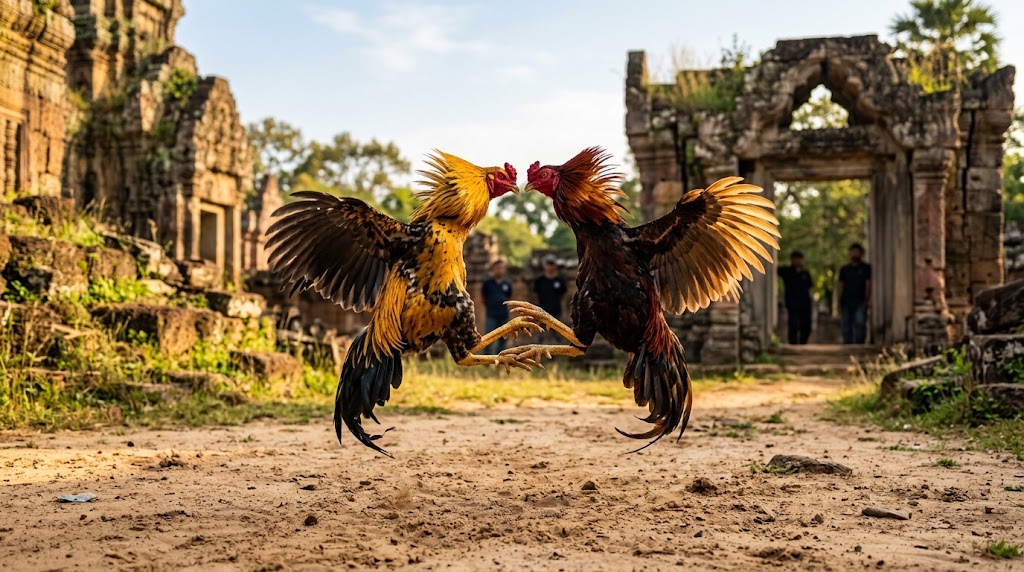
Rooster Fighting : Meaning, History and Natural Rooster Behavior
Rooster Fighting commonly refers to an organized contest involving roosters, while natural fights between male chickens can arise from social competition. The two subjects are related but not identical. Their historical and cultural meanings also vary by region, so claims about origins, customs and legal status need clear geographic and historical context.
What Is Rooster Fighting?
For readers asking what is cockfighting, the clearest answer is that it is a human-organized activity in which roosters are placed in opposition to one another. The term describes the organized activity, not every aggressive encounter that occurs naturally between male chickens.
This distinction matters because the same birds can be discussed in two very different contexts. Animal-behavior research examines how domestic fowl interact within a social group. Historical and cultural research examines how people have organized, interpreted or opposed cockfighting in particular societies. Evidence from one context cannot automatically answer questions in the other.
Natural Rooster Fights and Organized Cockfighting Are Not the Same
Natural aggression is part of the social behavior researchers observe among domestic fowl. Organized cockfighting, by contrast, depends on human involvement and has its own historical, cultural and welfare dimensions. Treating the two as identical hides the difference between animal behavior and a human-created event.
| Point | Natural Rooster Aggression | Organized Rooster Fighting |
|---|---|---|
| Context | Social interactions among birds | A human-organized activity |
| What evidence can explain | Hierarchy and male competition in studied domestic fowl | Historical, cultural and welfare issues within defined places and periods |
| Main limitation | Not every fight has one universal cause | Customs, rules and laws cannot be generalized worldwide |
| Coverage here | Behavioral explanation | Meaning and context, not operational instructions |
Why Do Roosters Fight Naturally?
The question why do roosters fight does not have one explanation that fits every encounter. One documented context is competition among males. A 2017 peer-reviewed study by Charlotte Rosher and colleagues examined domestic fowl (Gallus gallus domesticus) and described social hierarchies in which dominant males commonly interrupted mating attempts by subordinate males. The researchers also found that dominant males interrupted unrelated subordinates more often than related ones, showing that aggressive interactions varied with the social relationship in the studied groups.
These findings help explain one form of male-male competition, but they do not prove that every rooster fight has the same cause. Readers seeking separate guidance about housing and routine management can consult How to Raise Gamefowl.
A Regional History of Cockfighting
Any account of the history of cockfighting needs geographic limits. Historical evidence documents cockfighting in different societies, but the sources used here do not establish one uncontested place and date of origin. A more accurate approach is to examine documented regional examples instead of turning separate evidence into a single global timeline.
Cockfighting in English Social History
In a 2025 peer-reviewed historical study of English society from approximately 1750 to 1835, Mike Huggins connected cockfighting with wagering, debates about animal suffering and broader arguments about public behavior. The study shows that opposition developed through several social and moral concerns rather than through one simple cause. This evidence describes England during a defined historical period; it does not establish a universal history or explain current law.
Cultural Meaning in Bali
In his 1972 ethnographic essay, Clifford Geertz examined the Balinese cockfight as more than a contest between birds. His analysis interpreted it within local social relationships, status and cultural meaning. The essay illustrates how a cockfight can carry meanings tied to a particular social and cultural setting. Those conclusions belong to the Balinese setting and should not be applied automatically to every part of Southeast Asia.
Rooster Fighting Facts Supported by Research
The most useful rooster fighting facts are those connected to a named source and a defined scope. Research supports several careful conclusions: domestic fowl can form social hierarchies; male-male aggression can occur in mating competition; cockfighting has carried different social meanings in England and Bali; and health practices involving fighting cocks can raise antimicrobial-resistance concerns.
These findings come from different disciplines and cannot be combined without qualification. Behavioral research explains interactions among birds. Historical research examines change over time. Ethnography interprets culture, while veterinary and public-health research investigates health practices. Keeping those evidence types separate produces a clearer picture than treating every source as proof of the same claim.
Welfare and Public-Health Concerns
A study led by Abrao J. Pereira, published in 2025, reported a cross-sectional survey conducted from February to March 2023 among 275 fighting-cock owners in selected urban areas of Timor-Leste. Among the 269 respondents with relevant antimicrobial-use data, 205, or 76.2%, reported using antimicrobials. Of those 205 users, 175, or 85.4%, cited treatment of fight wounds as a reason for use.
The study documents practices within its sampled population and identifies conditions that may contribute to antimicrobial-resistance risk. It does not establish global rates, and it should not be treated as evidence that owners in Thailand or every other country follow the same practices. Its value lies in providing specific empirical evidence while making the population and limitations visible.
How Can Readers Check Online Rooster Fighting Claims?
Online pages can mix factual information with promotional wording, so those elements should be evaluated separately. The wording of เว็บตรง ปลอดภัย does not by itself establish the safety, licensing, reliability or official status of the linked service. Claims of that kind require independent verification.
Readers should also be cautious with broad claims about ancient origins, universal customs or worldwide legality. A claim may sound plausible while still extending far beyond its source. Checking whether the evidence concerns animal behavior, cultural interpretation, historical records or current regulation helps prevent one type of information from being mistaken for another. A page that repeats a statement is not automatically independent evidence for it, so the original publication and its stated scope should be checked directly where possible.
Why Does Regional Context Matter?
Readers may also encounter a เว็บพันธมิตร focused on bullfighting rather than rooster fighting. Information about a different animal activity cannot establish facts about rooster fighting. The animal, activity, location and period should match the claim being checked.
Summary
Rooster Fighting is best understood as a human-organized activity that must be distinguished from natural aggression among male chickens. Research can explain particular aspects of rooster hierarchy, historical change, cultural meaning and health practices, but every conclusion has a defined scope. Accurate explanations identify that scope instead of presenting one origin story, one cultural meaning or one legal status as universal.
Frequently Asked Questions
What is cockfighting?
Cockfighting is a human-organized activity involving roosters placed in opposition to one another. It is not a term for every naturally occurring aggressive encounter between male chickens.
Why do roosters fight naturally?
Research shows that male competition and social hierarchy can contribute to aggressive interactions. However, no single explanation applies to every encounter or flock.
Is every fight between roosters considered cockfighting?
No. Roosters can display aggression during ordinary social interactions. Cockfighting refers to an activity organized by people, so the presence of two fighting birds alone does not establish the same context.
Where did cockfighting originate?
Historical accounts appear in several regions, but the sources examined here do not establish one uncontested place and date of origin. Regional evidence should be described separately rather than combined into a definitive origin claim.
Is cockfighting legal everywhere?
No single worldwide answer applies. Legal status depends on jurisdiction and can change over time. Current information should be checked with the relevant official authority in the location concerned.
References
- Rosher et al. (2017): Relatedness and age reduce aggressive male interactions over mating in domestic fowl
- Pereira et al. (2025): Knowledge and practices related to antimicrobial use in fighting cocks
- Huggins (2025): From popularity to suppression: cockfighting and English society c.1730 to the 1835 Cruelty to Animals Act
- Geertz (1972): Deep Play: Notes on the Balinese Cockfight